AI Workflows
Agentic Workflows: Describe the Automation, Ship the Automation
How a Keldio-connected AI agent turns the long list of automations you have been meaning to build into shipped flows — handling the trigger logic, action wiring, branching, edge cases, and testing for you.
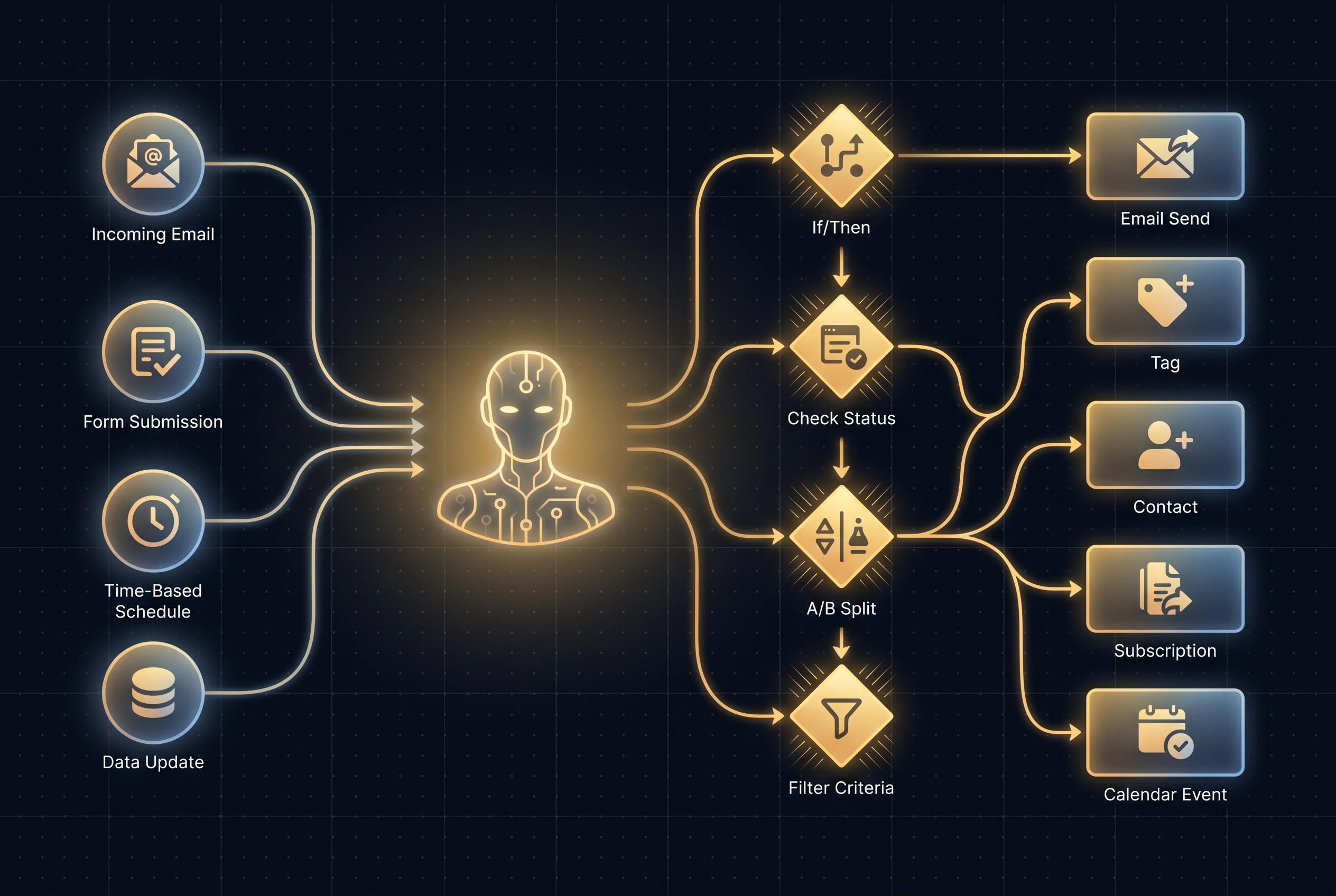
Most automation tools give you a faster canvas. Keldio removes the canvas from your job entirely. You describe what should happen. Your agent builds the workflow, wires it into your stack, tests it, and ships it.
The automations that never get built
Every business has a list of automations that "we should set up sometime". Tag this kind of buyer. Follow up if a call isn't booked. Pause the nurture when someone purchases. Notify the team in the inbox when a refund comes in. Send a welcome sequence to a new course member. Re-engage cold leads on a schedule.
The ideas aren't the bottleneck. The cost-per-automation is. Each one means picking a trigger, defining the audience, choosing actions, configuring delays, building branches, writing the copy or the payload, deciding what happens on error, testing it on a real contact, then keeping it alive when something upstream changes. Visual builders make this more visual; they don't make it faster. The workflows that should have been live months ago stay in someone's head — or worse, stay as a draft no one finished.
Keldio collapses the cost-per-automation. The workflow you'd build if you had the afternoon gets shipped while you're describing it.
How it works
You speak or type the automation to your AI agent. Something like:
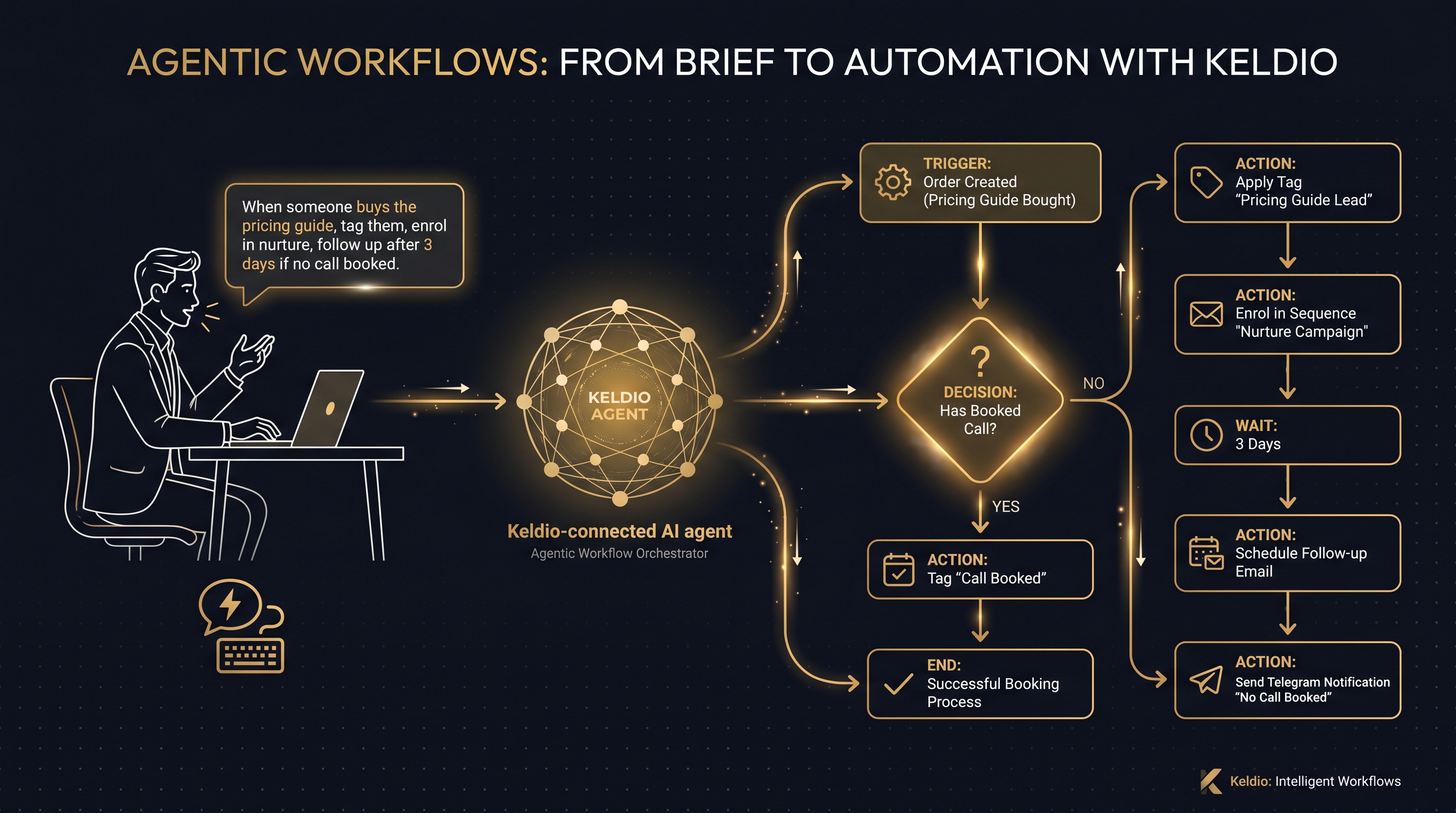
When someone buys our pricing guide, tag them, enrol them in the nurture sequence, and follow up in three days if they haven't booked a call. If they book, stop the sequence and let me know in the inbox.
That's the entire spec. No node-by-node click-through, no branch diagrams to draw, no decisions about how to express each condition.
From a brief like that, your Keldio-connected AI agent can:
- Pick the trigger. Identify the right event — order created for a specific product, in your live tenant, with the right filters.
- Build the branches. Conditional logic for "has booked a call" vs "hasn't booked", with the right wait windows and exit conditions.
- Wire every action. Apply the tag, enrol the contact in the named sequence, schedule the follow-up email, push the notification into your inbox.
- Configure the delays and timing. Three days means three calendar days respecting time zones, not 72 elapsed hours regardless of when the trigger fires.
- Handle the edge cases. What happens if the contact unsubscribes mid-flow. What happens if the order refunds. What happens if the email bounces. What happens if the sequence is already running. Decisions made and configured, not deferred to runtime surprises.
- Connect to the rest of your stack. Pull the right sequence by name from your email module. Match the inbox routing rules. Respect the tenant's tag system. Touch the CRM record with the right context, not orphan data.
- Test the path. Run a synthetic contact through the workflow, verify each step lands, surface anything that didn't.
- Ship it. Activate the workflow, link it to its trigger source, make it live.
- Watch what happens. Read enrolment numbers, step completion rates, drop-off points after the workflow runs in production.
- Suggest revisions. Surface where contacts are dropping out, propose tweaks — different wait window, different copy, different conditional — and apply them on your approval.
You review the brief, the agent's plan, and the result. You adjust if something isn't quite right. But the construction work — the part that normally turns "I want to automate X" into a Saturday afternoon and three browser tabs — is no longer yours to do.
Why this hasn't been possible before
There are two halves of the same problem, and no system has solved both at once until now.
On one side, traditional workflow tools — every visual automation builder you've ever opened — have the operational reach. They can fire on triggers, run conditions, call actions, hold state, retry on failure. But they were designed for a human at the canvas, dragging nodes and configuring them through forms. Some have added AI assistance over the years: a sidebar that suggests a next step, a prompt that drafts copy for one node, a template you can clone. None of them let an agent actually construct a workflow end-to-end, wired into the live business, on a brief. The human still clicks. Every node, every time.
On the other side, generic AI tools have the intelligence. They can describe a workflow in plain English, sketch the branches, write the email copy, summarise what the automation should do. But they sit beside your business, not inside it. They can't open your workflow builder, can't see your existing tags, can't pick the right sequence by name from your library, can't activate the workflow, can't monitor it after it runs. The output is a description. The human still has to build it.
Keldio is the first platform built explicitly for the agentic model. Every meaningful action — picking triggers, constructing branches, configuring actions, connecting to your CRM and email and inbox, testing on synthetic data, activating, monitoring, and revising — is exposed as something an agent can actually do, not just describe. Bring your agent of choice — OpenClaw, Hermes, Claude Code, Codex, or any other agentic AI system — connect it to your Keldio workspace, and the human is no longer the builder. The human is the source of intent.
That's the unlock. AI workflow suggestion is a feature. AI workflow execution is the platform.
What this means for you
The list of "automations we keep meaning to set up" finally gets shipped. Not by you, in a focused Saturday. By your agent, in a conversation. The lead-magnet follow-up that's been a sticky note for six months becomes a live workflow over coffee. The refund notification you keep forgetting to wire up gets built and tested in five minutes. The renewal nurture sequence you sketched on a napkin actually runs.
You bring the intent. Your Keldio-connected AI agent builds the system. Automation stops being a backlog and starts being a thing you do in the time it takes to describe what should happen.