AI Agents
Bring Your Own Agent: Connect Your AI to the Operating Layer of Your Business
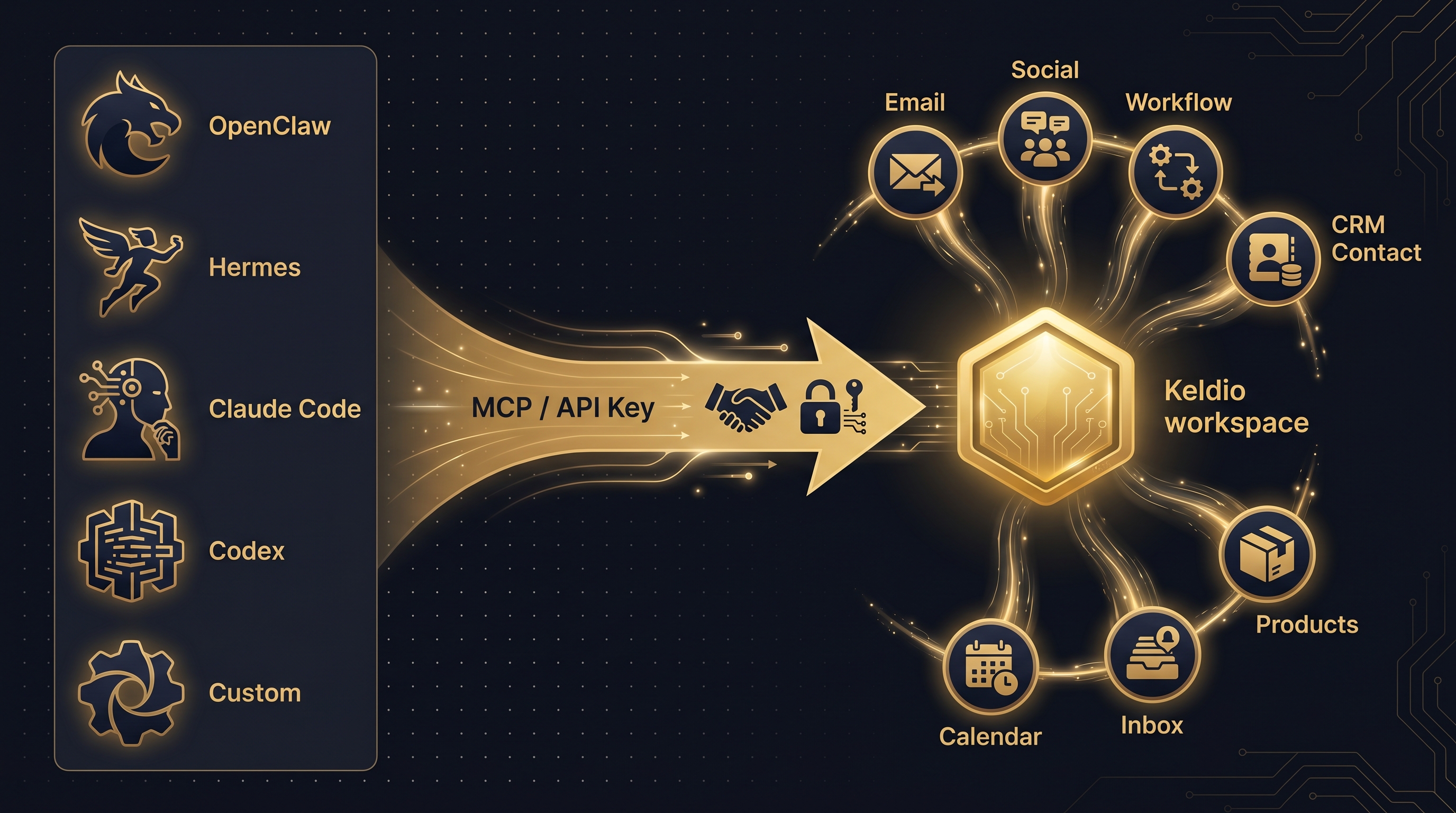
Keldio does not ship an AI agent. It ships the operational surface any agent can drive — bring OpenClaw, Hermes, Claude Code, Codex, or any agentic AI system, and the agent you already trust runs your business.
Most platforms ask you to use their AI. Keldio asks you to bring yours. Connect the agent you actually want — OpenClaw, Hermes, Claude Code, Codex, or any other agentic AI system — to your workspace, and the agent runs the business through the same operational surface you use.
The agent you don't get to choose
The standard pattern in SaaS today is a single proprietary AI assistant baked into the product. You get whoever the vendor decided to ship. The model is fixed. The capabilities are fixed. The reasoning depth is fixed. If a better agent comes out next quarter, you don't get it — your platform does, on whatever timeline they choose. If you've already built your operating muscle around a particular agent — OpenClaw on your phone, Claude Code at your desk, Codex in your terminal — none of that transfers to the inside of your business platform. You context-switch between your real agent and the platform's built-in stand-in.
Keldio is built the other way around. The platform doesn't ship an agent. It ships an operational surface that any agent can drive. The choice of agent is yours.
How the Agents admin works
Inside the Keldio Agents section, you connect an external AI agent to your workspace. Two paths:
- MCP (Model Context Protocol). The native, agentic-first connection. Your agent acts as an MCP client; Keldio exposes a full MCP server with hundreds of tools spanning email, CRM, products, workflows, inbox, courses, communities, social, payments, analytics, settings. Standard protocol, no proprietary bindings.
- API key. A bearer-token authenticated REST surface that covers the same operational territory. For agents and automations that prefer raw HTTP, or for use alongside MCP.
Both paths are scoped, audited, revocable. Each connected agent shows up in the Agents library with its own identity, scope set, and activity log. You can have one agent or several, with different scopes per agent — a marketing-only agent that can manage email and social but can't touch billing, a support-only agent that can read the inbox but can't publish anything public, a power agent with the full surface.
The agents you can bring
The model is intentionally open. Any agentic AI system that can speak MCP or call a REST API can become an operator inside your workspace. In practice today, that includes:
- OpenClaw. Local-first agent runtime running on your own machine or device, with multi-model routing, voice and image generation, and integrated telegram + scheduling. Often deployed as a personal operator for the founder.
- Hermes. The orchestration agent for multi-agent setups, coordinating delegated tasks across other agents.
- Claude Code. Anthropic's coding-and-operations agent, strong for technical workflows that touch both your codebase and your Keldio workspace.
- Codex. OpenAI's agentic coding interface, similarly capable when wired to a Keldio API key.
- Your own agent. Anything you build on top of an MCP-capable framework or HTTP client — internal tools, custom orchestrators, vertical agents — can drive Keldio the same way the named ones do.
The agents do not run inside Keldio. They run wherever you run them. Keldio just gives them an authenticated, scoped surface to operate on your behalf.
Why this hasn't been possible before
There are two halves of the same problem, and no other business platform solves both.
On one side, traditional business platforms expose their operational depth but were never built for agents at all. There's no MCP surface, no agent identity, no scope system, no agent-aware audit log. Everything assumes a human at the controls, optionally with a built-in AI sidekick the vendor shipped. Outside agents can't drive the business through these systems — at best they read a few endpoints.
On the other side, AI assistants and agentic frameworks have the intelligence and the protocol literacy. They know how to plan, call tools, recover from failures, hand work to other agents. But they need somewhere to operate. A general-purpose AI agent without an operational surface to drive is a smart conversationalist, not an operator. It can describe what should happen in your business; it can't make it happen.
Keldio is the first platform built explicitly to be operated by any agent the customer brings. Every meaningful action — sending email, building workflows, managing contacts, posting to social, running checkout, replying in the inbox, publishing content — is exposed as a tool an agent can actually invoke. The agent operates. The platform executes. The human supervises and approves.
That's the unlock. Other platforms ship an AI. Keldio ships a surface for the AI you already trust.
What this means for you
You don't get locked into one AI ecosystem to run your business. The agent you've trained on your voice, your context, your way of working — the one that already knows you — can drive your operations directly. If a better agent ships next year, you connect it. If you want one agent for marketing and another for support, you wire both. If a model upgrade ships at three a.m., you get it the moment you point your agent at it.
Your business operating system stays put. Your operator can change as fast as the field does.